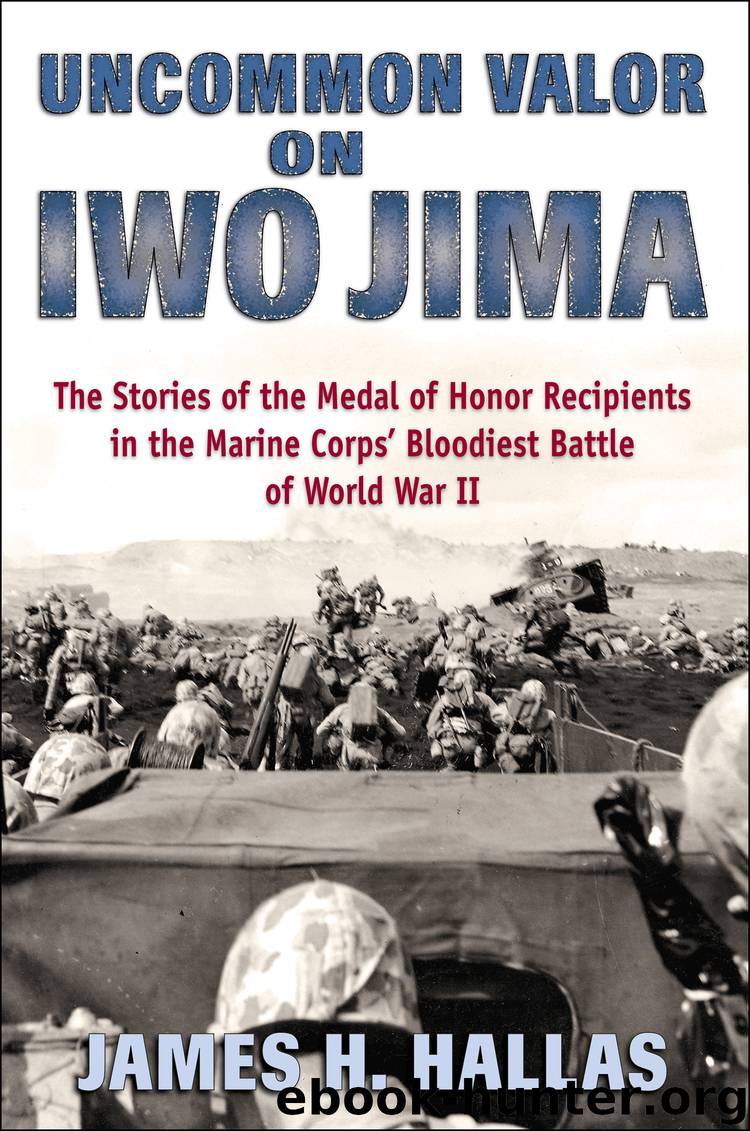
Uncommon Valor on Iwo Jima by James H. Hallas
Author:James H. Hallas [Hallas, James H.]
Language: eng
Format: epub
Publisher: Stackpole Books
Published: 2016-03-24T17:01:58+00:00
Unable to shake Bill Harrell’s hand, President Truman grasps the hero’s arm above the hook replacing his right hand. Harrell became amazingly proficient with his hooks. USMC
It was Harrell’s good fortune that a noted Philadelphia surgeon, Capt. Henry Kessler, was chief of orthopedics at the Mare Island Naval Hospital. Kessler developed a process where utilitarian “hooks” were screwed into plastic cuffs on the stumps of the amputated wrists. These were connected to cables attached to the opposite shoulder, allowing Harrell to open and close his right hook by moving his left shoulder, or use the left hook by moving the right shoulder.
On October 5, 1945, wearing his new hooks, Bill Harrell received the Medal of Honor from President Truman in a ceremony at the White House. Several other men also received their medals at the ceremony, including Greg Boyington, Woody Williams, Doug Jacobson, and others. Truman liked to tell people that he’d rather have the Medal of Honor than be president, but he didn’t say that to the young Texan whose arms now ended in steel hooks. He was visibly moved as Harrell’s citation was read and the sergeant came to a snappy salute. “The President gripped Harrell’s right arm at the elbow and shook it warmly. “All I can say, Sergeant,” said Truman, “is that this medal is small enough tribute for what you have given for your country.” Truman might have been slightly less misty-eyed had he known that moments before, as the medal recipients walked in to the awards ceremony, Harrell had reached out with his hook and goosed the hero in front of him.
Harrell was discharged from the Marines on February 9, 1946. Less than two weeks later, he married Larena Anderson, a clerical worker he had met while undergoing treatment and rehabilitation at Mare Island Naval Hospital. Their son, William Carter—named after Harrell’s Iwo Jima comrade—was born in 1947; a daughter, Linda Gail, followed in 1948. The proud residents of his hometown of Mercedes raised $25,000 to enable him to buy a small ranch. Another gift was a palomino stallion that he named Charlie. Harrell taught himself to ride Charlie with his hooks. “He didn’t let anything stop him,” his son Bill said years later.
In fact, Harrell attacked his handicap with the same fortitude he had demonstrated against the Japanese. Over time he became amazingly dexterous with his hooks. He could pick up a cigarette without crushing it, and had the dexterity to dial the phone and fire a rifle. He enjoyed guns and shot frequently at local ranges, even designing a special device to let him shoot a pistol. “He could do anything,” recalled his nephew Richard Harrell. “He could drive a tractor, type on a typewriter, light a cigarette, or pick up a dime off the floor. . . . There was nothing he couldn’t do.”
Despite the gift of the ranch, in late 1946 Harrell moved to San Antonio to take a job with the Veterans Administration. He was named chief of prosthetic and sensory aids at the San Antonio Veterans Administration regional office in 1948.
Download
This site does not store any files on its server. We only index and link to content provided by other sites. Please contact the content providers to delete copyright contents if any and email us, we'll remove relevant links or contents immediately.
Becoming by Michelle Obama(10033)
Beartown by Fredrik Backman(5768)
The Last Black Unicorn by Tiffany Haddish(5643)
Man's Search for Meaning by Viktor Frankl(4612)
The Book of Joy by Dalai Lama(3996)
The Five People You Meet in Heaven by Mitch Albom(3575)
In a Sunburned Country by Bill Bryson(3548)
The Choice by Edith Eva Eger(3477)
Full Circle by Michael Palin(3455)
The Mamba Mentality by Kobe Bryant(3289)
The Social Psychology of Inequality by Unknown(3039)
Imagine Me by Tahereh Mafi(2972)
Book of Life by Deborah Harkness(2943)
The Checklist Manifesto by Atul Gawande(2863)
Less by Andrew Sean Greer(2701)
A Burst of Light by Audre Lorde(2614)
The Big Twitch by Sean Dooley(2440)
No Room for Small Dreams by Shimon Peres(2376)
Everest the Cruel Way by Joe Tasker(2347)
